LEXICONMachine components
Rotary manifold
Also called: Centre swivel, hydraulic swivel joint, rotary union
The joint at the centre of an excavator's slew axis that carries hydraulic oil between the rotating upper structure and the fixed undercarriage while the machine turns continuously in either direction.
What it does
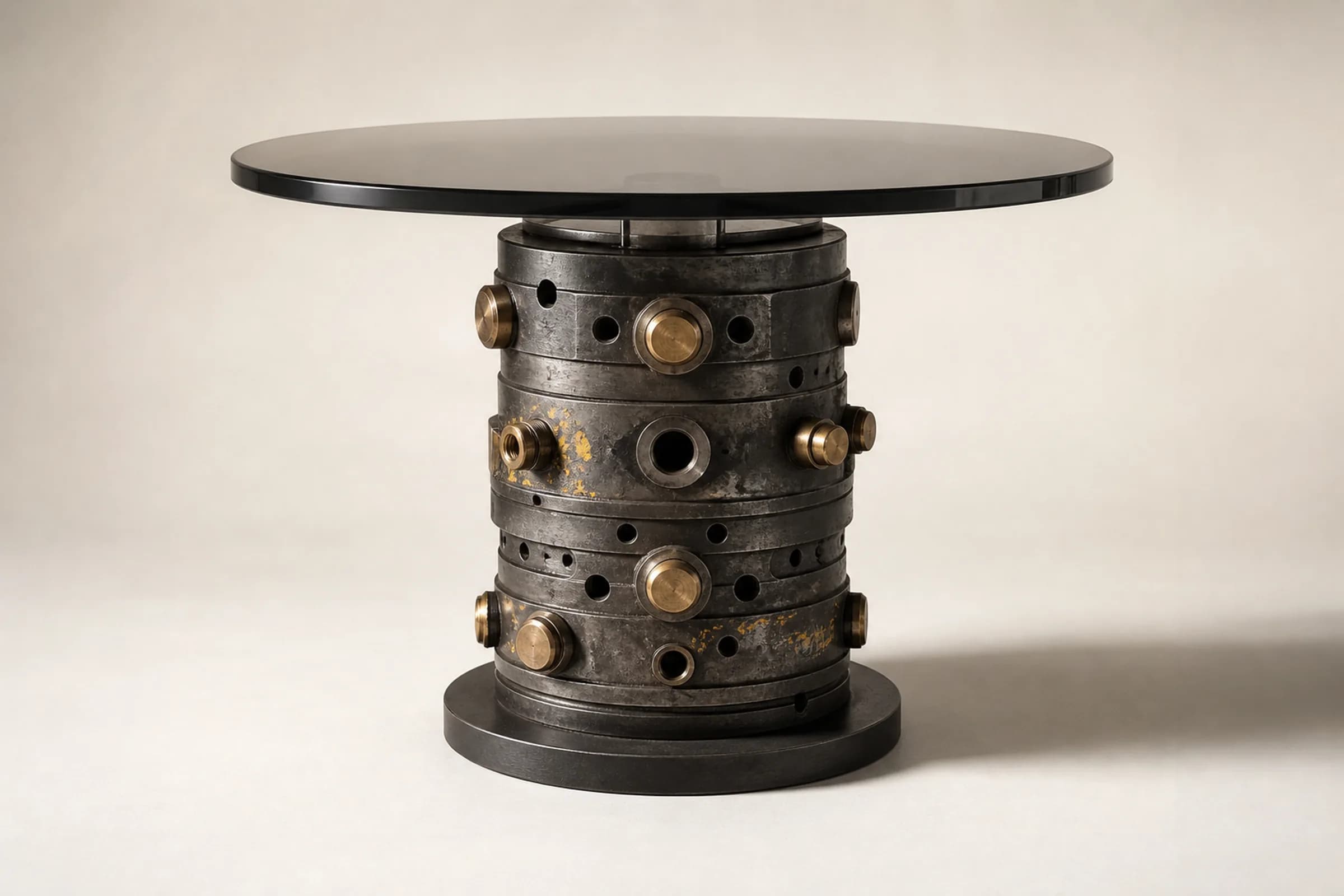
Without it, the hoses feeding the travel motors would twist off within two rotations. The manifold is a machined shaft inside a housing, with annular grooves and seals forming separate oil galleries at different heights — typically four to eight circuits: two travel motors, sometimes a blade cylinder, a brake release and a drain. Oil crosses from a fixed port to a rotating one through each groove, sealed against pressures of several hundred bar while the surfaces slide continuously.
Why it becomes an object
It is the most precisely machined component in the undercarriage, and it looks it: concentric bands, radial ports, threaded bosses and lapped sealing surfaces. Retirement follows seal wear and cross-leakage between circuits rather than any structural fault, so the body arrives intact with its machining perfectly preserved. Set upright, it reads as a turned cylinder with an obvious axis, and the port bosses give a radial rhythm that no fabricated form produces naturally.